What Is a Drop-Stitch Pool? The DWF Technology Explained
title: "What Is a Drop-Stitch Pool? The DWF Technology Explained" slug: "what-is-drop-stitch-pool" description: "A drop-stitch pool is a high-pressure inflatable pool with rigid walls and real swimming depth. Here's how DWF technology works, why it matters, and who makes them." publishedAt: "2026-05-28" updatedAt: "2026-05-28" author: "GIGI FRANCE Editorial Team" category: "Technology" readingTime: "8 min" coverImage: "/images/blog-what-is-drop-stitch-pool.jpg" relatedArticles:
- "drop-stitch-vs-steel-frame-vs-inflatable-pool"
- "how-deep-should-above-ground-pool-be"
- "how-to-install-drop-stitch-pool"
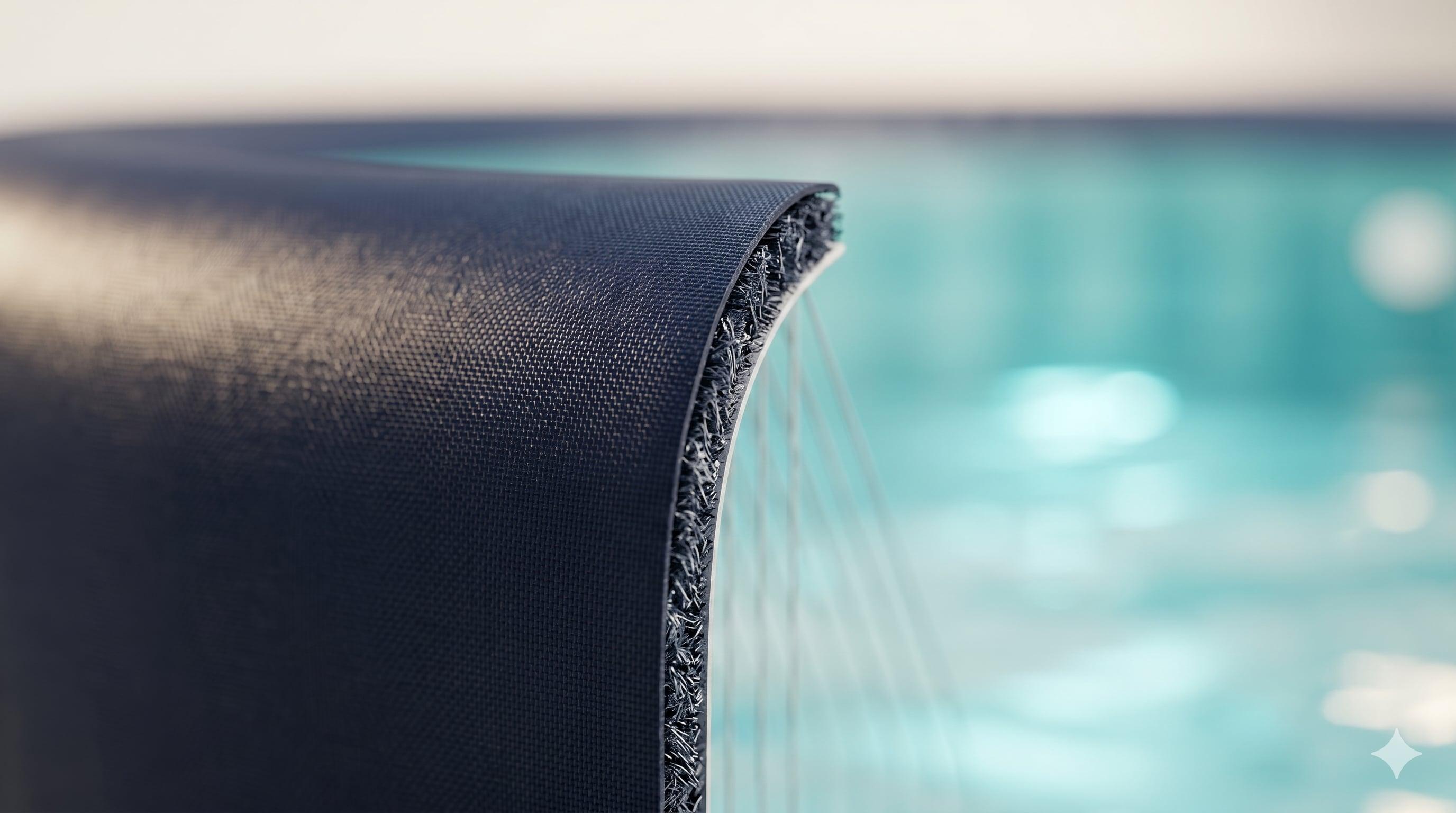
A drop-stitch pool is a high-pressure inflatable pool built from DWF (Dacron Woven Fabric): two layers of PVC-coated fabric connected by thousands of tightly woven internal polyester threads. When inflated to 10–15 PSI, the threads prevent the walls from expanding outward, producing flat, rigid surfaces. The result is a portable pool that stands and behaves like a semi-permanent above-ground structure — without concrete, without a steel frame, and without a building permit.
That's the short answer. If you're evaluating whether a drop-stitch pool is the right choice for your backyard, the rest of this article covers the technology in detail, compares it to standard inflatables and steel frame pools, traces where the technology comes from, and explains what to look for when comparing brands.
How Drop-Stitch Works: The Internal Thread Structure
Standard inflatable pools work by trapping air in a sealed PVC chamber. At 1–2 PSI, the air pressure pushes outward in all directions equally, creating soft, rounded walls. This geometry limits both rigidity and wall height — the walls bulge under water pressure, and the pool base spreads outward at the bottom.
Drop-stitch construction solves this differently.
Inside the wall of a DWF pool, there are thousands of short polyester threads — hence "drop stitch" — running vertically between the inner top and bottom faces of each wall panel. These threads are woven into the fabric at a specific length: the target wall thickness. When the pool inflates to working pressure, the air pushes the two fabric faces apart, but the threads — held at their fixed length — prevent expansion beyond that point. The result is a flat, rigid panel, not a rounded bulge.
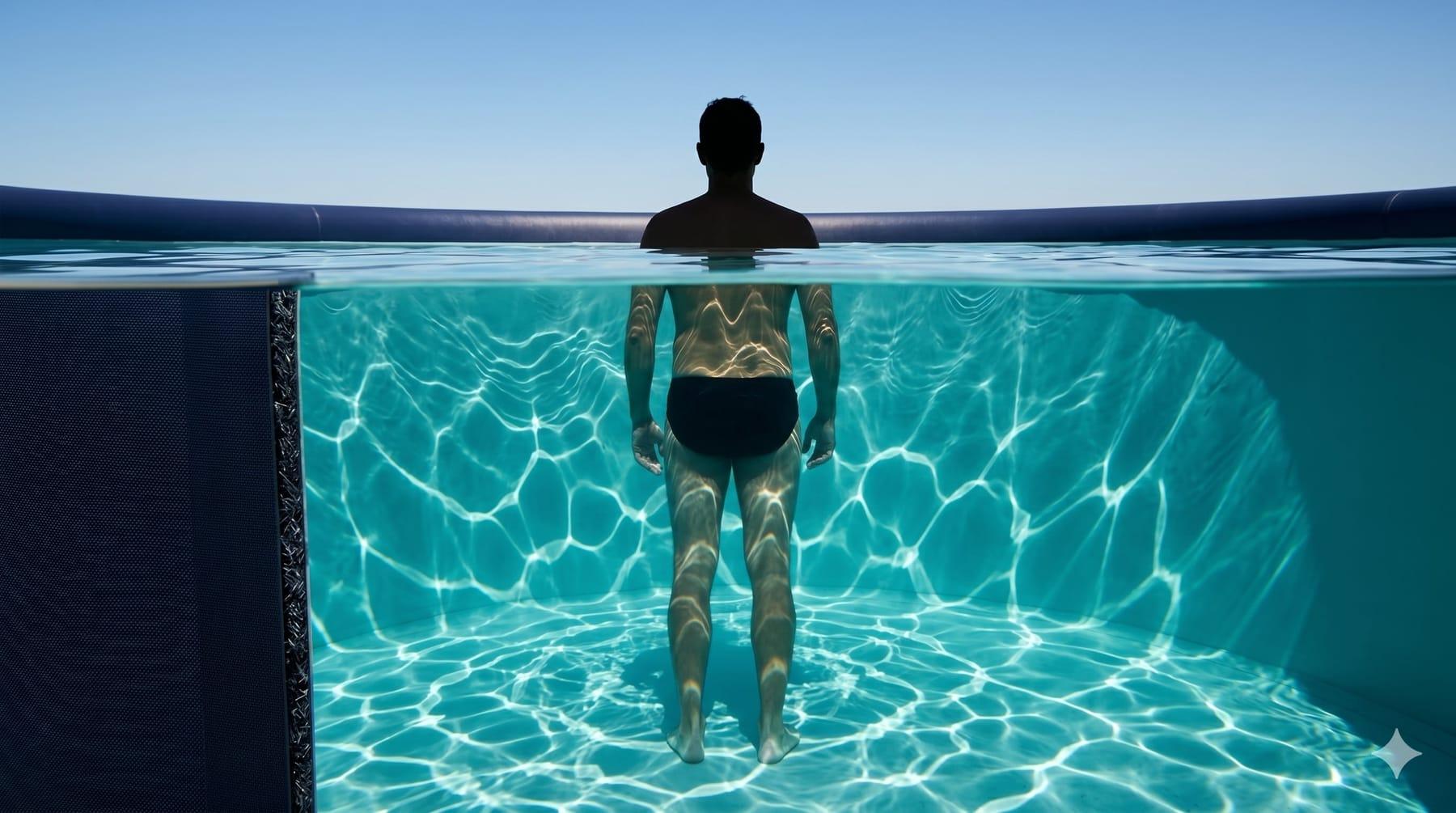
At 10–12 PSI (the working pressure of GIGI pools), the walls are rigid enough to support a 5 ft column of water — approximately 59 inches — without significant deformation. A standard inflatable at 1–2 PSI cannot do this. The pressure differential is roughly 10×.
Why pressure matters for depth. Wall height in an inflatable pool is directly constrained by how much outward force the walls can resist. At 2 PSI, the wall is flexible — it can only hold a short column of water before the wall base starts spreading outward. At 10–12 PSI, the rigid walls hold their geometry under significantly greater water loads. This is the mechanical reason drop-stitch pools reach 5 ft while standard inflatables top out at 33-36 in.
What DWF (Dacron Woven Fabric) Is
DWF stands for Dacron Woven Fabric. It is a composite material:
- Outer layers: Two sheets of PVC-coated woven polyester fabric, typically rated at 1,000 denier or higher for pool applications.
- Internal weave: Thousands of polyester threads connecting the two faces, perpendicular to the surface plane.
- Core construction: The entire assembly is thermally bonded or RF-welded at the seams, not just glued.
The term "Dacron" refers to a brand name for polyester fiber developed by DuPont, now used generically in the industry to describe this class of high-tenacity woven polyester. In practice, drop-stitch materials from reputable manufacturers use high-grade polyester regardless of whether the "Dacron" brand name applies strictly.
DWF is the same material class used in high-performance stand-up paddleboards (SUPs), inflatable kayaks, and military/industrial inflatable structures. The key properties that matter for pool applications:
- Temperature tolerance: -4°F to 180°F (-4°F to 176°F), which covers US climates including the Texas summer heat and Northern winters in storage.
- UV resistance: Superior to standard PVC, particularly with UV-stabilized outer coatings.
- Puncture resistance: Significantly higher than standard PVC at equivalent wall thickness. The woven polyester substrate provides tear resistance that smooth PVC lacks.
- Pressure holding: The material holds air pressure over extended periods without significant loss, provided valves and seams are intact.
The Origin of Drop-Stitch Technology
Drop-stitch construction was not invented for pools. It originated in industrial and military applications — inflatable shelters, pressurized tubing, inflatable aircraft components — where high rigidity at low weight was the engineering requirement.
The consumer breakthrough came through water sports. In the late 2000s and early 2010s, paddleboard manufacturers began applying drop-stitch to SUPs (stand-up paddleboards). The goal was to produce a paddleboard that was as rigid as a solid fiberglass board but could deflate and roll into a backpack. The technology worked: inflatable SUPs at 12–15 PSI are sufficiently rigid for competitive paddling.
From paddleboards, the construction migrated to inflatable kayaks and then to larger water applications. Pool manufacturers — initially in Europe, then in North America — recognized that the same structural principle that made a 4 in-thick paddleboard rigid at 12 PSI could produce a 5 ft pool wall rigid at 10 PSI.
The drop-stitch pool market in the US is still early. It sits between the established mass-market (standard inflatables and steel frame pools at $300–$1,500) and permanent in-ground or semi-in-ground pools ($35,000+). The segment is growing as buyers in the $3,000–$6,000 range look for products that offer genuine swimming depth without the construction cost and permanence of inground pools.
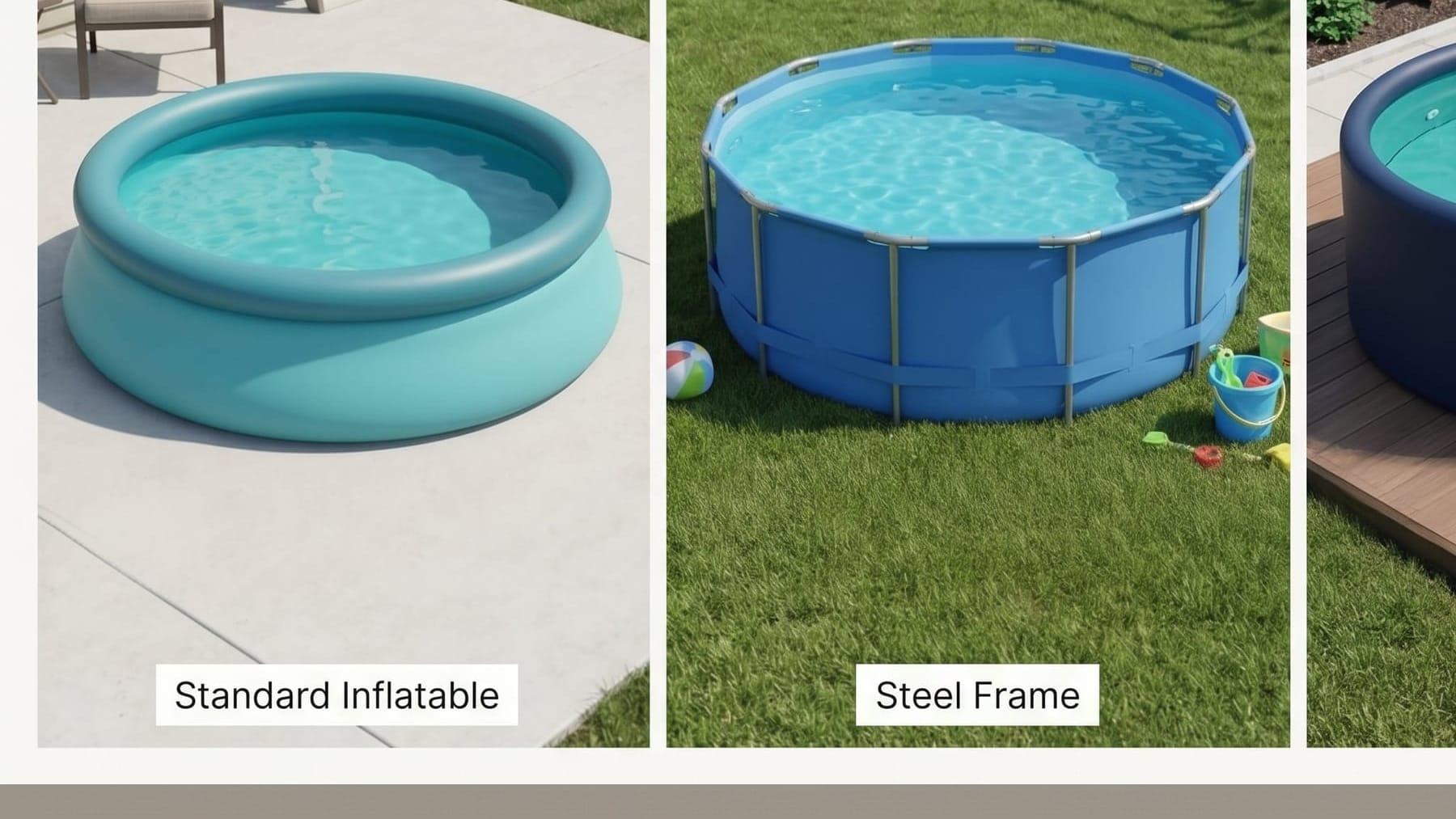
Drop-Stitch vs Standard Inflatable: The Technical Comparison
| Standard Inflatable | Drop-Stitch Pool | |
|---|---|---|
| Working pressure | 1–2 PSI | 10–15 PSI |
| Wall construction | Smooth PVC, air-filled | DWF with internal thread mesh |
| Wall shape under pressure | Rounded, bulging outward | Flat, rigid |
| Maximum practical wall height | ~36 in | 5 ft (59 in) and above |
| Can adults swim? | No — wading only | Yes, at 5 ft depth |
| Expected lifespan | 1–3 seasons | 5–10 seasons |
| Puncture resistance | Low | High (woven substrate) |
| Portability | Yes | Yes |
| Setup time (inflation) | 20–30 min | ~1 hour |
The fundamental difference is what happens at the wall. In a standard inflatable, the air pushes equally in all directions — the wall rounds outward because there is nothing stopping it. In a drop-stitch pool, the internal threads impose a fixed geometry. The pool inflates to its designed shape and holds it.
Drop-Stitch vs Steel Frame: What Changes
Steel frame pools and drop-stitch pools can reach similar depths — the Intex Ultra XTR reaches 52 in, and drop-stitch pools like GIGI reach 5 ft. The comparison between these categories is less about depth and more about construction philosophy.
A steel frame pool is structurally rigid because of the frame. The liner is passive — it holds water but the steel carries the load. The frame must be assembled piece by piece, cannot be stored compactly, is vulnerable to rust at connection points, and cannot be relocated without full disassembly.
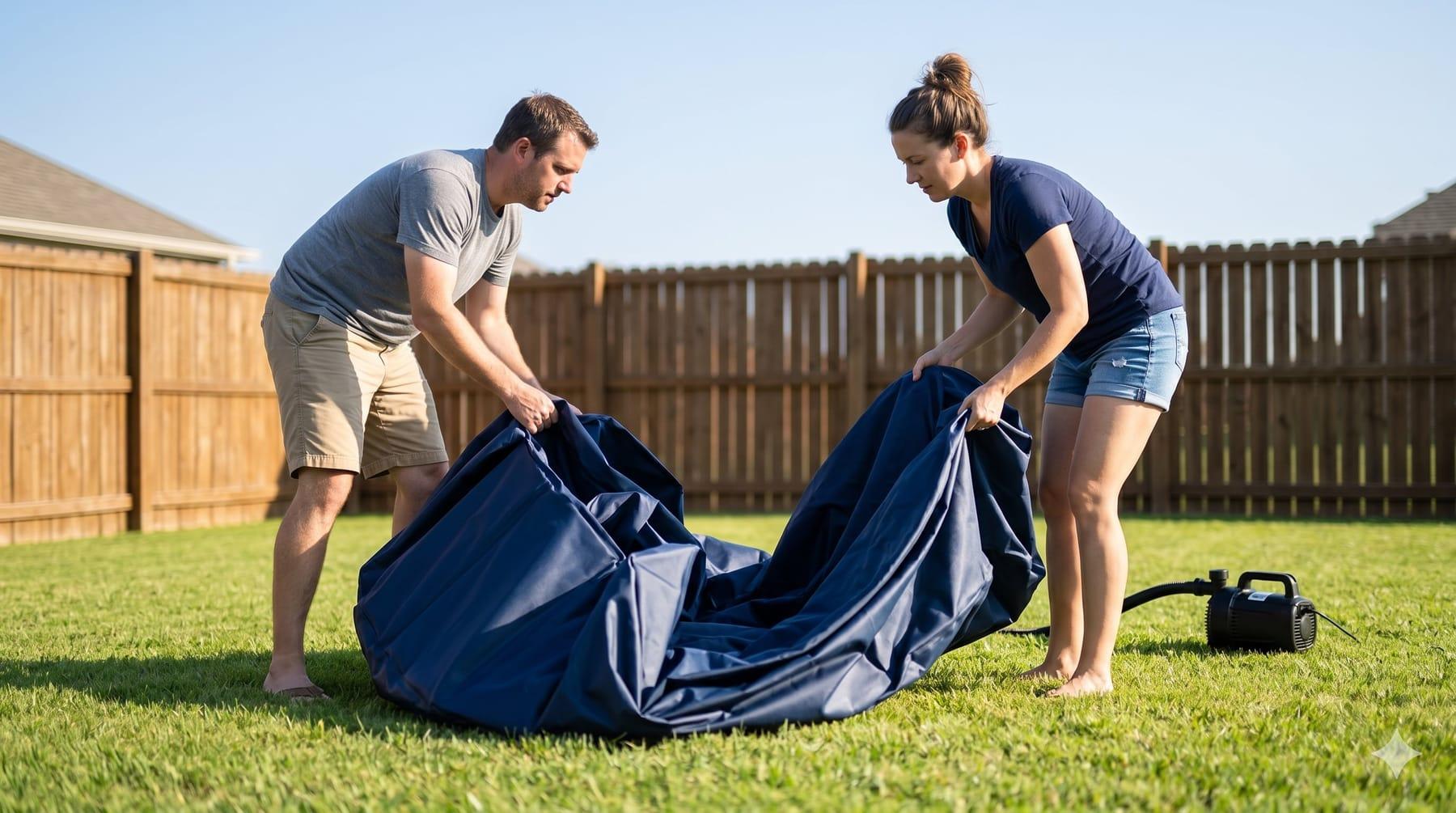
A drop-stitch pool is structurally rigid because of air pressure and thread geometry. The structure deploys from its packed form to a functional pool in approximately one hour, deflates in 30 minutes, and stores compactly. No rust. No frame sections to lose or damage. It returns to its original packed footprint for off-season storage.
At 5 ft, GIGI pools match or exceed the depth of most steel frame options at a fraction of the setup complexity.
Who Makes Drop-Stitch Pools Today
The US market for drop-stitch pools is still developing, with a small number of direct-to-consumer brands:
Perfect Pool (US) offers 16ft, 20ft, and 24ft models at 52 in (52 inches) depth. Their 16ft pool sells at $4,999 without filtration. They are the best-known drop-stitch pool brand in the US as of 2026.
GIGI FRANCE (French brand, US market via UNISHOP LLC) offers 13ft, 16ft, and 19ft models at 5 ft (59 inches) depth — the deepest drop-stitch pools currently available in the US. Each pack includes the pool, sand filter 330W, electric pump, and repair kit. Priced from $2,999. See the GIGI pool lineup.
iPoolGo (global brand) offers a wide size range with variable depths, primarily targeting international markets with some US presence.
Beyond these brands, there are various direct-from-manufacturer imports on Amazon with inconsistent quality and limited warranty support.
What to Look for When Comparing Drop-Stitch Pools
Wall height. This is the primary specification. 52 in (52 inches) is the current standard among established brands. GIGI offers 5 ft (59 inches) — 7 in more, which translates to approximately 1,600 additional gallons on the 16ft model and genuinely deeper swimming for adults.
Working pressure and material rating. A drop-stitch pool rated for 10–15 PSI is structurally sound. Be cautious of pools that don't publish their pressure ratings — it typically means the material isn't designed for the higher end of drop-stitch specification.
What's included. Drop-stitch pools at $3,000+ often sell the pool body alone, requiring separate purchase of pump, filtration, and ladder. GIGI packs include the sand filter 330W — the filtration standard used in residential in-ground pools — as well as the electric pump and repair kit. (Pool cover and carrying bag are sold separately as upsells.) Verify what you're actually getting before comparing prices.
Warranty. A 2-year manufacturer warranty (as offered by GIGI) is the minimum to expect for a product in this price range. Shorter warranties, or warranties that require the buyer to pay return shipping on a 62 lbs pool, are red flags.
Ladder compatibility. Standard pool ladders are designed for 52 in pool walls. On a 5 ft pool, a standard ladder reaches too low — the top step falls inside the pool wall rather than at the rim. GIGI offers a full drop-stitch ladder (59 inches / 5 ft) specifically designed for their pool depth, made from the same DWF material as the pools.
Related Reads
- Drop-Stitch Pool vs Steel Frame vs Inflatable: Which Is Right for You?
- How Deep Should an Above-Ground Pool Be? The Adult Swimmer's Guide
- How to Install a Drop-Stitch Pool: Complete Step-by-Step Guide
The GIGI 16ft drop-stitch pool — 5 ft deep, 7,000 gallons, sand filter 330W included — is available at $3,999 with free shipping to the continental US. View the full GIGI pool lineup.
Related Reads
Ready to find the right pool for your backyard?
Explore GIGI Drop-Stitch Pools